
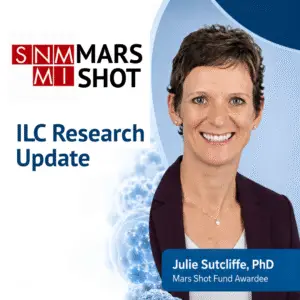
 Dr. Julie Sutcliffe, professor of internal medicine and biomedical engineering at the University of California, Davis received a $500,000 grant from the 2023 Society of Nuclear Medicine and Molecular Imaging (SNMMI) Mars Shot Research Fund that focuses on invasive lobular carcinoma (ILC) and testing an approach to detect and ultimately treat it. LBCA was excited to check in with Dr. Sutcliffe about this project and the potential impact for patients with ILC.
LBCA: We were excited to learn that this large grant from SNMMI was focused on ILC. Can you briefly explain the aims of your project and what you hope it will demonstrate for patients with ILC?
Yes, we are extremely grateful to the SNMMI Mars Shot funding for our proposal titled “[68Ga]Ga DOTA-5G as a diagnostic imaging agent for metastatic/advanced invasive lobular breast cancer (LBC).” The aims of the proposal are to conduct a prospective study using the [68Ga]Ga DOTA-5G PET/CT imaging in patients with invasive lobular breast cancers. The [68Ga]Ga DOTA-5G is a radioactive peptide that targets a protein on cancer cells call the integrin αvβ6. We hypothesize that a) [68Ga]Ga DOTA-5G will detect lesions in patients with LBC, b) [68Ga]Ga DOTA-5G will be safe and well tolerated, and c) [68Ga]Ga DOTA-5G will be more sensitive than 18F-FDG PET.
LBCA: How does the radioactive molecule you are studying differ from others like FDG and FES that are used with PET scans? Why does this radioactive molecule seem promising? What are the relative benefits for patients and providers in using this radioactive molecule ?
[68Ga]Ga DOTA-5G is a radiolabeled peptide that targets a cell surface protein called avb6. This protein is not found on healthy tissue but is found on many cancers including breast cancer. This molecule differs from FDG and FES in many ways a) it is labeled with 68Ga-gallium, a radioisotope with a short radioactive half-life, only 68 minutes as compared to FES and FDG molecules that are radiolabeled with fluorine-18. b) it targets the cell surface protein αvβ6 as opposed to glucose metabolism or estrogen receptor, c) it is not taken up in healthy brain unlike FDG and d) it is not taken up by healthy liver unlike FES We are hopeful that [68Ga]Ga DOTA-5G will identify lesions, in particular those in the brain or liver sooner than other imaging modalities.
LBCA: We understand you are also interested in the field of theranostics–where the imaging sensitive target can be exploited (or used) to target and deliver a strong radiation dose to the cancer cell. Does your study address this? If not, is that where you hope this work might lead?
Yes we are very interested in theranostics and have several active clinical trials using a radiothernostic approach. The current trial funded by the SNMMI Mars Shot only utilizes the imaging agent [68Ga] DOTA-5G, with the goal to establish this agent to detect ILC however we have developed the therapeutic agent [177Lu]Lu-DOTA-ABM-5G. This therapeutic molecule is radiolabeled with Lutetium-177 and delivers strong radiation to cancer cells. We absolutely hope that in the future we are able to use [177Lu]Lu-DOTA-ABM-5G to treat ILC.
LBCA: How is the project going thus far? Is this a clinical trial? If yes, what phase clinical trial and how many patients do you hope to enroll in your study?
The project is going well. This is a Phase I study with the goal to accrue 30 patients. Accrual was a little slow to start with but we have now enrolled 5 patients.
LBCA: When is your study planned to be completed? What would be the next steps in research in this area before changes to patient care would occur broadly, if any?
We hope to complete accrual in the next 12-18 months. Once we have established that [68Ga] DOTA-5G can detect lesion we will activate additional trials at sites beyond UC Davis, expanding into Phase II.
LBCA: Is there anything else you would like to share with us about this exciting research project?
Our preliminary results are promising and we look forward to sharing them at the SNMMI annual meeting in LA later this month. We look forward to providing an update to the LBCA community soon thereafter.