The 2026 Annual Society of Clinical Oncology’s (ASCO’s) annual meeting, always held at McCormick Place (on the Lake) in Chicago, attracted 46,000 medical professionals, research and patient advocates this year. It’s hard to describe just how huge an event this is, focused on the science of all forms of cancer. The five-day meeting includes sessions in massive halls (holding 10,000(!) seats) with jumbotrons to view the speakers and panel presentations in “smaller” 1,000-person auditoriums.
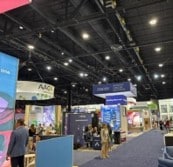
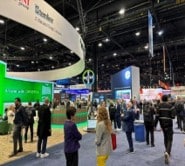 The sessions are focused on the science and it is important to read up on the terms used, and the treatment administration or screening methodologies or biology described. On the lighter side, you can easily lose yourself as I did twice in the large 3-story-high centrally located exhibit hall. It holds a vast number of mammoth-sized booths of pharmaceutical and life sciences companies, and more modest tables of smaller cancer centers and nonprofit organizations. All offer new products, databases, new drug details and other educational information, and, of course, more bling than you can imagine – including freshly baked cookies, branded pens, crafty techno gadgets, and (a personal favorite) popcorn. One small section houses a patient advocate pavilion and, happily, a therapy pet. In another, you can have a free professional head shot taken and emailed to you. A patient advocate lounge (for all cancer types) located in a room above the fray offers free meals, livestreamed sessions and a place to network and rest your feet.
 It can all be a bit daunting for a patient advocate attending for the first time, as I did five years ago, seeking new research about lobular breast cancer. That first time, being more accustomed to the annual symposium on new breast cancer research in San Antonio, I was immediately struck by the small number of sessions at ASCO dedicated to breast cancer of any type. As it is the most common cancer in women, and second most common cancer worldwide, I had thought there would be more. When I learned that there had never been a session at ASCO on lobular breast cancer, I became determined to change this.
It took several attempts to have ASCO include the ILC education session we developed and proposed with our LBCA scientific advisory board (SAB), but after a couple of attempts, it was approved for this year’s conference. The challenge had been to develop a presentation of comprehensive and actionable information that clinicians could use in treating their lobular breast cancer patients, given that no protocols exist yet for how to do so. Last October’s study on ILC published by The American Cancer Society (a study strongly urged by LBCA), likely generated clinician interest in the unique aspects of ILC. The study reiterated that ILC is truly different from the more common ductal breast cancer, very under-studied and incredibly, that ILC diagnoses are increasing at a higher rate than all other breast cancer types in women of all ages.
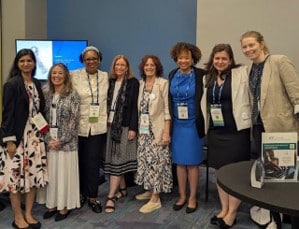
I flew to Chicago in a state of eagerness. This ASCO 26 felt different from previous years, with the inclusion of a patient-centered focus. This was, I learned in a special meeting with ASCO’s outgoing president, Dr. Eric J. Small, very much intentional. And that translated clearly into another first at ASCO – a panel with breast cancer patient advocates and oncologists about the importance of including patients in the development of clinical trials, on which I was invited to speak.
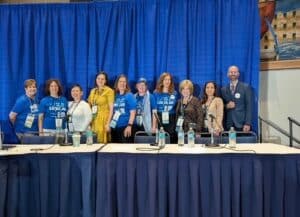
 The morning of our session, I was joined by several ILC patient advocates who arrived early, wearing our blue “Ask Me About Lobular” t-shirts and LBCA buttons. We stood outside the room, handing out hundreds of our informative ILC/LBCA brochures, urging clinician audience members to please share these with their lobular breast cancer patients. The presentation about Tailoring Management for Invasive Lobular Carcinoma, moderated by LBCA’s own SAB member Dr. Rita Mukhtar was informative and focused precisely on what clinicians needed to hear. You can view the presenters slides here:
- Dr. Matt Covington: Modern Imaging of Metastatic Invasive Lobular Carcinoma: Anatomic and Molecular
- Dr. Rinath Jeselsohn: Evidence and Exceptions in Systemic Therapy for Invasive Lobular Carcinoma
- Surgical Right-Sizing in Invasive Lobular Carcinoma: Extent, Margins, and Nodes
The 1,000- seat hall was standing room only. The Q&A session went up to the last minute. And virtually no one left our brochures behind. This was a historic moment for ILC and for LBCA. I am so thankful to the volunteers and advocates who joined me and helped create a visible presence for Lobular at this large event.
We look forward to seeing more ILC sessions at ASCO as the science rapidly advances and ILC finally garners the attention it needs.