
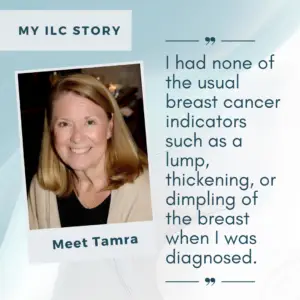
 My name is Tamra and I’m from Mantua, Ohio. I’m a Registered Nurse and work as a Care Coordinator in the Neurological Institute at the Cleveland Clinic in Cleveland, Ohio. I was diagnosed with invasive lobular breast cancer stage 2 on 9/24/24 after my yearly mammogram. My imaging indicated a faint “architectural distortion” that was picked up by the radiologist. I had none of the usual breast cancer indicators such as a lump, thickening, or dimpling of the breast. I did, however, notice that I was experiencing a very slight change in the shape of my breast that I had dismissed for quite some time. (Only after my surgery did I realize that breast shape change was also a sign of breast cancer.) My oncologist said it was a “good news and bad news” situation. The bad news was that the lesion was invasive lobular breast cancer (ILBC). I didn’t even know what that was! The good news was it was caught early; especially with my dense breast diagnosis, which doesn’t usually happen with invasive lobular cancer.
I was given the choice of either a complete mastectomy without radiation or a partial (lumpectomy) mastectomy with radiation. Chemotherapy would be considered after surgery once the MammaPrint (genetic analysis) of the lesion was known. I spent hours of sleepless nights laying in my bed scrolling for research survival data for ILBC patients with full mastectomy versus partial. As a nurse, I’m familiar with performing medical research but I was very surprised and frustrated by the overall lack of research information available on ILBC. The ILBC research cohort studies were all so small and didn’t give me a clear understanding. In the end, I chose a partial mastectomy with radiation with concurrent bilateral breast reconstruction at the Cleveland Clinic where I work.
I wish I had found the Lobular Breast Cancer Alliance (LBCA) as soon as I was diagnosed. For me, it has provided a sense of community and a consolidated, caring voice in the wilderness of misinformation or no information. The LBCA has shed light on a clear health care disparity that needs to be rectified. I cannot sit by and do nothing with the knowledge that only 1% of breast cancer research money is designated specifically to lobular breast cancer research when its occurrence in the general population is 10-15%. I also need to be more comfortable with the treatment plan offered to ILBC patients so that it is research specific for ILBC. I am adding my voice and effort to the cause and will actively support the LBCA.
Are you interested in telling others about your own lobular breast cancer story? Please email communications@lobularbreastcancer.org to request information about how to submit your story.