
My name is Kim, I’m 55 years old, and I live in Massachusetts.
I have been getting annual mammograms since the age of 40, due to family history – my mother died at age 60 from metastatic breast cancer. She was initially diagnosed at age 45 and had a single mastectomy and chemotherapy. Fifteen years later, cancer would take her from me. I was only 30 years old and pregnant with my first child, whom she never got to meet because she passed away when I was 7 months pregnant.
In early 2023, I had my annual mammogram as usual. I just assumed I’d get the yearly letter that states I have dense breasts and should get the suggested follow-up ultrasound, which I did the previous year, and it was clear. This time, I received a message for a follow-up mammogram and ultrasound due to a suspicious area in my right breast. The ultrasound confirmed the same suspicious area that the mammogram showed. It was a small area that they suspected was just a cyst, so it was initially suggested that it just be watched and followed up with a mammogram in 6 months. However, after I got dressed to go home, the radiologist popped his head in the room and said that he noticed my family history and that he strongly suggested I get an MRI, “just to be 100% sure”. I was reluctant to get an MRI, because I’m claustrophobic and have severe anxiety over MRIs. I put off scheduling it for a couple of weeks, but because my husband and sister (who is a nurse) pleaded with me to do it, I finally made the appointment.
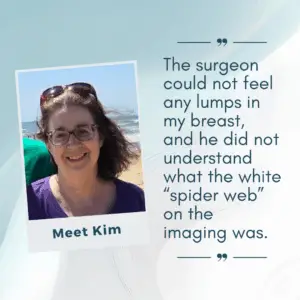
The MRI was not as bad as I imagined because I was able to go in feet first vs. head first. I did my breathing and got through it. What happened next was not at all what I expected. A few days later, I got an urgent call from radiology stating the MRI showed a larger area of mass and that I needed a biopsy right away! I turned to my sister for advice, and she set up an appointment with a well-trusted general surgeon she worked with. He reviewed the MRI and agreed that a biopsy was best, even though he could not feel any lumps in my breast, and he did not understand what the white “spider web” he was seeing on the imaging was.
After dealing with the insurance company to get the referral I needed to get the biopsy ordered, I finally went. It was not a pleasant experience. The surgeon called me as soon as the results came in (I was signing paperwork to buy a new car and stepped outside of the dealership to take the call!). It was a positive result – lobular breast cancer. He did give me one positive note – ILC is a “lazy” cancer. It is slow-growing. He told me he knew a wonderful breast surgeon in Boston that had been practicing for over 30 years, so I agreed and had an appointment with her 2 weeks later.
I went to the hospital scared to death about what will happen and what my future will look like. In just that 2 week time span, a hard area could now be felt in my right breast. It could have been the cancer growing or a result of the bruising from the biopsy, which was still very bruised and painful. The doctor told me because of the size of the cancer relative to the size of my small breasts, a lumpectomy was not an option – I would need a mastectomy. I knew I wanted it all out, so I agreed and even asked about a double mastectomy. She gave me the facts and shared patient experiences, and in the end I stuck to getting a DMX. I went back and forth about reconstruction, but I wanted the least amount of risk and surgeries, and I had a very supportive husband, so I opted for a double mastectomy to flat (no implants). Luckily, I did not need chemo or radiation due to the lymph nodes being clear post-surgery.
Two years later, I am still getting used to my new body, but I am forever grateful for those medical professionals who helped save my life. I was “lucky,” in that my cancer was found at stage 0/1, but many women do not always have that outcome, and it is not found until stage 2, 3 or 4 due to ILC not being felt or detected on regular imaging.
As soon as I was told I had Lobular breast cancer, I knew I needed to learn as much as I could about it so I can advocate for myself during treatment and beyond. LBCA is an amazing resource to continue to keep updated on research and new developments in treatment. I am very grateful for LBCA. I am hopeful that more funding and research will be done in the coming years to help detect and treat ILC differently than IDC due to its unique characteristics.