
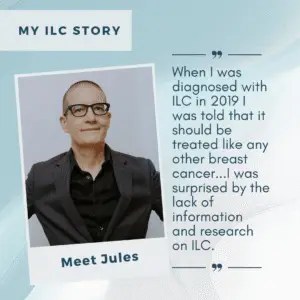
 I was 52 and very athletic when I felt a swollen lymph node doing push-ups. It took weeks of imaging and biopsies to find out that I had lobular invasive carcinoma (ILC), a diagnosis that came Christmas Eve of 2019. I had never heard of ILC but was told that ILC should be treated like any other breast cancer subtype, so I set off on an aggressive course of chemotherapy, surgery, and radiation. My chemotherapy was halted when I came down with COVID in March of 2020, before anyone knew much of anything about COVID. When my treatment resumed, I found myself enduring a mastectomy and 25 bouts of radiation completely alone. Wanting to understand my cancer better and having a background in research, I scoured PubMed and other scientific sources to find out more about lobular breast cancer. I found precious little until I landed on the LBCA website. Finally, I felt like I could make informed decisions and ask smart questions about my care.
Forced into early menopause by my treatment and struggling with the side effects of the aromatase inhibitors, it took a while to find my grounding again. I set myself a goal of running a 10K to get back in shape and tried to put the cancer diagnosis behind me, and in the process, I became an avid runner. But then, in November of 2022, I noticed that my running times were getting slower, and I was dropping weight. My annual PET scan that December caught what my oncologist called a “large area of concern.” Ultimately, I learned that my breast cancer had metastasized to my ovaries and omentum. I had another surgery and was put on a regimen of fulvestrant and a CDK4/6 inhibitor. So far, this treatment has worked well for me – I currently have no evidence of active disease.
While I feel grateful and lucky to be doing well, I have been surprised and frustrated by the lack of information and research about ILC, which affects about 15% of people with breast cancer. As someone living with metastatic ILC, I was shocked to learn that people with metastatic ILC are routinely kept out of clinical trials [because eligibility for clinical trials often requires that participants have “measurable disease,” which metastatic ILC is not], that there is no real information on how ILC should be treated differently from other types of breast cancer, and that, until recently, there was very little research focused specifically on ILC.
That’s why I was so happy to find an organization like LBCA, that is not only doing critical education but also working to advance ILC research. As someone who worked in research (albeit in a different field), I really value the way LBCA works to ensure that patient advocates and patient perspectives are at the center of their research and advocacy work. This has inspired me to try to get more involved with ILC research myself. We can do better, and we must, and patients living with ILC should help lead the way.
Are you interested in sharing your own lobular breast cancer story? Please email communications@lobularbreastcancer.org to request information about how to submit your story.