
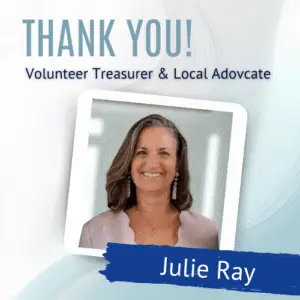
 When Julie Ray was diagnosed with invasive lobular carcinoma in the summer of 2023, she had never heard that breast cancer had types. Three years later, she’s a volunteer treasurer for LBCA, co-lead of the LBCA Local Advocacy Team, the Lobular Awareness Network of The Carolinas, and someone who shows up regularly at cancer conferences, hospital imaging centers, and oncology offices to make sure clinicians are aware of what is known about ILC and provide comprehensive information about ILC and LBCA to their patients.
LBCA sat down with Julie to hear about two recent advocacy wins that demonstrate just how much one determined person can accomplish.
Julie’s first story begins in San Antonio at the San Antonio Breast Cancer Symposium (SABCS), one of the most prestigious breast cancer conferences in the world, drawing 10,000 attendees each December. Julie was there as an LBCA travel grant recipient and had identified Dr. Antoinette Tan, a breast oncologist at the Levine Cancer Institute within Carolina-based Atrium Health, as a speaker worth meeting. Dr. Tan had listed invasive lobular carcinoma in her speaker profile and was also, Julie noted, an SABCS plenary committee member. “I knew she would be incredibly busy,” Julie recalls. “So I sort of expected to be a little bit brushed off.” She came prepared anyway: card in hand, her key questions written on the back. The moment Dr. Tan’s session ended, Julie stepped forward.
Dr. Tan didn’t brush her off. She agreed to connect and followed through. In January, the two had a 30-minute Zoom call. Julie had already shared LBCA’s patient resources in advance so Dr. Tan could come prepared. The result? Dr. Tan became Julie’s internal advocate at Atrium Health, connecting her with the head of nurse navigation and the coordinator for patient education programs.
On July 15th, Julie will be one of two patient panelists on an Atrium Health webinar dedicated exclusively to lobular breast cancer — alongside fellow LAT member Kathie Nejberger. An Atrium breast oncology professional will present the clinical science, and Julie and Kathy will share the patient perspective. “It’s a foot in the door,” Julie says. “And every way in is about humility, politeness, and respecting the fact that the medical industry is doing what it does with the tools it has.”
Showing Up Before the Appointment
Julie’s second story is more personal and just as instructive on effective patient advocacy. Before a routine ultrasound at Piedmont’s Women’s Diagnostic Imaging Center, Julie dropped off a packet for whoever would be handling her care. Inside was a cover letter requesting that both the imaging technician and the radiologist complete a free CME course on ILC offered by LBCA through Memorial Sloan Kettering’s online clinician training portal, along with a copy of a recent ASCO article summarizing the latest research on invasive lobular carcinoma — from imaging to surgical treatment to therapy.
“I said: before you evaluate my scan and issue a report, please complete this course,” she explains. Three days later, the radiologist emailed back to confirm he would do both before her appointment.
He did. He even attended the appointment in person, and told Julie that based on her lobular diagnosis and reconstruction history, her next step should be a breast MRI. He also told her: “This actionable, simple, straightforward approach to patient advocacy is the best that I’ve seen.”
Advice for Fellow Advocates
For other ILC patients or advocates wondering how to create similar results, Julie’s guidance is clear: go in person when you can, bring documentation, and be ready to ask for the next step before the current conversation ends. “Face-to-face humanizes and personalizes the story,” she says. “And when you find a medical professional who is deeply curious and interested in learning more, you can go a long way.”
She also emphasizes humility and patience not as strategies, but as genuine values. “They can only work with the tools in their toolbox. Our job is to offer them a way to make that better.”
Looking ahead, the Lobular Awareness Network of The Carolinas, now about 12 members strong, is expanding this approach across both states, distributing cover letters and research summaries to hospital systems throughout their region, signing up for the Komen Walk in Charlotte, and building toward greater visibility at local events and beyond.
Julie’s message to anyone watching or reading: be persistent, but be patient. “I didn’t expect anyone to turn things around in a week. They’re navigating a complex system. But once you start the conversation, you’ve got your foot in the door. And you have to be ready to ask for the next step.”
Julie Ray is LBCA’s volunteer treasurer and co-lead of the LBCA LAT, Lobular Awareness Network of The Carolinas. To learn more about Local Advocacy Teams (LATs) or to get involved click here.