
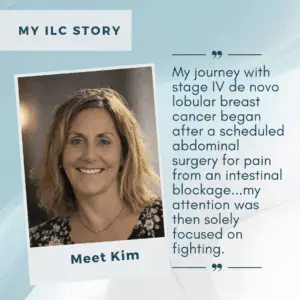
 This is the story of my journey with stage IV de novo lobular breast cancer. Most of you who are reading this know of the blur that the days spent in the hospital become in recollection. Mine are no different. It was late June and it was beautiful outside. At least it looked beautiful from the hospital window. My son’s baseball schedule was in full effect and I was missing it. I was admitted for scheduled abdominal surgery after pain from an intestinal blockage took me to the emergency room. I spent four nights in the hospital, healing from surgery. The surgeon took a piece of my small intestine, sent it to pathology, and we waited for my abdomen to heal to the point I could go home. Waiting.
Backtracking to day two in the hospital, I stared ahead at the moving colors and shapes on the TV screen. My mind was racing and vacant at once, while I sat in a strange numbness that can only be explained as shock. The day before, I had alerted in the recovery room, just five minutes out of surgery. I was abruptly awake and was asking for details, after hearing my surgeon say the words “Stage IV cancer.” I wasn’t supposed to be able to be awake yet. I wasn’t supposed to hear her. The words “STAGE IV CANCER” had battered down the sedative defenses and broken thru to my consciousness. I thought: “This has to be a mistake. Everyone thought this was Crohn’s Disease. I can’t have cancer.” It didn’t compute. Shock. A disturbance in equilibrium and the permanence of something. That something was my health, my life, my longevity.
And then the pathology came back, a call came thru and identified the tumor as breast cancer. Stage IV invasive lobular breast cancer! Hardly good news to most people but to me, a psychologist embedded in a breast center, I knew enough about breast cancer treatment to know I had a shot at life now. Shock morphed to hope and the wheels on the machine started moving. My attention was then solely focused on fighting. I came across LBCA the summer I was diagnosed when searching for similar stories of lobular breast cancer. Finding LBCA helped me better understand my illness, validated my experiences and provided hope.
I have been NEAD (no evidence of active disease) for over one year now. That doesn’t mean I don’t think about my breast cancer every day, struggle with the side-effects of treatment, or fear the seemingly inevitable roadblocks of treatment change or progression in my future. As with many of us, breast cancer has changed me. I have shed the naivete of belief in my infallible health, I have grown more focused and deliberate in my daily goals and have leaned into my spiritual development. I have familiar experiences to draw from in my work with breast cancer patients and relate deeply to their struggles.
The concept of post-traumatic growth motivates me to explore the good that has happened as a result of this diagnosis. Strengthened relationships, clarity in purpose, and intentionality in activities are a few of the positives I can name at this stage of the journey. I am truly grateful that along the way I was able to find and connect to the LBCA and, in doing so, find direction, community and inspiration to champion advocacy efforts in lobular breast cancer.