
 My name is Jane and I am 56 years old. Breast cancer has been part of my family history for as long as I can remember. My mother was diagnosed twice in her late fifties, so I began having mammograms and breast screenings in my late twenties. I did everything I was supposed to do. I never missed an appointment. I had regular monitoring for decades. I was vigilant because I knew the risks.
At 53 years old, I never imagined that breast cancer would become part of my own story. In 2022, I discovered a lump in my breast. I knew something wasn’t right. I went through mammograms, ultrasounds, and MRIs, but every test came back reassuring. Again and again, I heard the same responses: “We don’t see anything.” “We don’t feel anything.” “You have dense breasts.” “You have lots of cysts.” But I knew my body. For an entire year, I advocated for myself. I kept asking questions. I kept pushing for answers. I kept insisting that something was wrong. While the imaging studies showed nothing concerning, my instincts told me otherwise. Finally, after a year of persistence, I demanded a biopsy.
In August 2023, I received the diagnosis that changed my life: Stage 2B Invasive Lobular Carcinoma (ILC). One of the hardest parts of my journey was how I learned I had cancer. Several days after my breast biopsy, I was out to dinner with friends when I received a notification that I had a new test result in MyChart. I opened it and immediately saw the words INVASIVE LOBULAR CARCINOMA. I didn’t understand everything I was reading, but I knew what the word carcinoma meant. I was devastated. But at the same time, I felt validated.
For a year, I had been saying something was wrong. For a year, I had trusted my instincts when the tests said everything was fine. At that moment, I finally had my answer. I soon learned that ILC is often referred to as the “sneaky” breast cancer. Unlike many other breast cancers, it does not always form a distinct lump and even when it does, it can be difficult to detect on mammograms, ultrasounds, and even MRIs. My experience became proof of something I now tell every woman: sometimes you know your body better than any scan.
My treatment began with a bilateral mastectomy. It was a difficult, life-altering decision, but I was determined to do whatever it took to fight this disease. Surgery marked the beginning of a new chapter, but it was far from the end of treatment and what I wasn’t prepared for were the side effects. There were days when I felt like I was losing pieces of myself while trying to save my life.
For the first year—perhaps even the first two years—I was in survival mode. I focused on appointments, surgeries, treatment decisions, and simply getting through each day. I did what needed to be done, but I don’t think I truly processed what had happened to me. Now, as I approach my fourth year, the emotions have finally caught up with me. The fear. The grief. The anger. The uncertainty. The loss. Only now do I fully appreciate the magnitude of what cancer took from me and what my body has endured. I’ve learned that healing is not always linear. Sometimes surviving comes first, and processing comes later.
Yet cancer did more than change me—it gave me purpose. Determined to understand my diagnosis, I immersed myself in learning everything I could about invasive lobular breast cancer. I found the Lobular Breast Cancer Alliance (LBCA), where I learned much more about this disease and immersed myself in all the information they had to offer. The more I learned, the more I realized how under-recognized and under-researched lobular breast cancer remains.
What began as a search for answers became a mission. I became a patient advocate with LBCA, using my voice and experience to help raise awareness and support other women diagnosed with this disease. I wanted to make sure women felt less alone, more informed, and more empowered to advocate for themselves.
Today, I have the privilege of working alongside scientists and researchers as a patient advocate on research grants focused on invasive lobular breast cancer. Sharing my patient perspective, and helping influence the future of research has helped transform one of the most difficult experiences of my life into something meaningful. Cancer took away my sense of certainty, but it also gave me a mission. Today, I am nearly three years into my journey.
I am a survivor. I am a bilateral mastectomy warrior. I am living with the realities of long-term hormone therapy. I am a patient advocate. I am helping advance awareness and research for invasive lobular breast cancer. Most importantly, I am still moving forward.
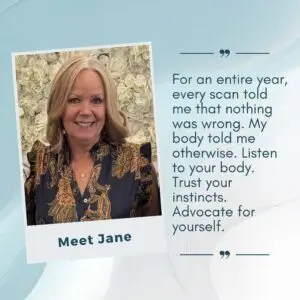
If there is one message I hope every woman takes from my story, it is this: Listen to your body. Trust your instincts. Advocate for yourself. For an entire year, every scan told me that nothing was wrong. My body told me otherwise. Demanding that biopsy may have saved my life. Cancer is part of my story, but it is not the whole story. The whole story is one of persistence, resilience, courage, and purpose. It is the story of finding my voice when no one could see what I knew was there. It is the story of turning one of the hardest experiences of my life into an opportunity to help others. And that may be the most important chapter of my story yet.