
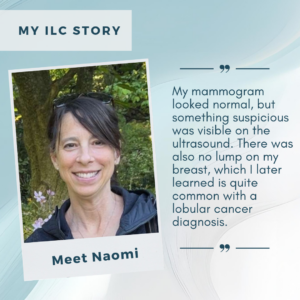
 I am a 58 year old mom and retired educator, living in Montclair, New Jersey. I was diagnosed with ILC (stage 1, grade 2, ER+/PR-/HER2-) in July of 2025 during my annual mammogram and ultrasound exam. My mammogram looked normal, but something suspicious was visible on the ultrasound, so they biopsied it and it came back as an 8mm tumor. It was quite a shock, as I was in what I considered to be excellent health. I ate well, ran regularly, didn’t smoke, and had a glass of wine a couple of times a week. I was training for my sixth NYC marathon when I was diagnosed, and while I did notice that I was a little more fatigued and short of breath on my runs than usual, I really didn’t think too much of it and attributed it to my aging body. There was also no lump on my breast, which I later learned is quite common with a lobular cancer diagnosis. Thank goodness I adhered to my regular mammogram/ultrasound schedule every year.
Things moved rapidly after diagnosis. Like many women, I was in complete shock and experienced a lot of grief and fear. At the same time, I had to suddenly immerse myself in the language of cancer, and learn all kinds of new terms like “hormone receptor status,” “ki67,” “Oncotype DX score,” “lymph node status,” etc. How little I knew back then! I didn’t even know enough to initially ask for the pathology report, and how the critical information contained within would help determine my course of treatment. When I saw the words “invasive lobular carcinoma,” I assumed that “invasive” meant that it was already all over my body. As I calmed down though, and began the process of researching and learning everything I could about my diagnosis, I realized that there was a path forward and that this was something that could be treated. One of the reasons I decided to become a patient advocate with Lobular Breast Cancer Alliance (LBCA) is because I want to help other patients in my position who could have used a “translator,” among other forms of support, at the beginning.
I met with the surgeon and underwent a lumpectomy in August 2026. I then underwent four rounds of chemotherapy (clinically the tumor was low risk given its size and lack of lymph node spread, but my Oncotype DX score was a 33, indicating a genomically high risk of recurrence), and then 30 rounds of radiation. I am currently on the aromatase inhibitor Letrozole for a projected ten years.
It has come as a surprise to me how difficult survivorship can be. I am not the same person I was pre-cancer, both physically and mentally. The trauma and the stress my body has endured, combined with the fatigue and joint pain from the maintenance therapy, have made me realize that it is not that easy to simply move on and “go back to normal.” The rate of recurrence is not small for breast cancer patients, and because I have people in my life that were initially diagnosed stage 1 only to develop metastasis several years later, I am especially fearful. Yet at the same time, I am hopeful given the medical advancements and treatment options now available. I feel so lucky and grateful to be here, even though I am a somewhat compromised version of myself. I was able to start running again after treatment, as I was intent on running the NYC marathon this year, because although cancer took a lot from me, it only made my zest for life and my determination even stronger than it already was. Although recovery from treatment put a wrench into my training, I completed the marathon a few weeks ago, a small triumph for me on my road to recovery. I also experienced the joy of having my two sons run it as well, and their unwavering support (along with that of my husband) definitely helped me cross that finish line!
Every patient diagnosed with breast cancer has a story, and no two situations are the same. It helps me to hear the experiences of other patients. As a retiree with adult children, I was able to devote myself fully to my treatment and recovery (with no distractions or other responsibilities), and I have ample time to focus on my health and well-being. I recognize what a privilege that is, and my heart goes out especially to the young women who are working and raising kids and now have to deal with a breast cancer diagnosis along with forced menopause, ovarian suppression or removal, and fertility concerns. This is why the work that LBCA is doing to raise awareness, educate people, and fight for a cure is so important and I am so happy to help in that effort.
I am truly thankful for LBCA. None of my medical professionals (surgeon, radiation oncologist, medical oncologist) took the time to delineate the differences in histology, potential treatment plans, and prognosis between lobular and ductal breast cancer. This needs to be changed, and anyone diagnosed with ILC needs to be provided with information specific to this particular and lesser known type of breast cancer. LBCA provided me with a wealth of scientifically-based and research-informed information that educated me in the comprehensive way I needed. I needed information that was specific to invasive lobular breast cancer, and I found it through the LBCA website, as well as a research and science based lobular cancer Facebook group. The support services offered on the LBCA website were the lifeline and the community I desperately needed during a very scary time in my life, and what I have learned through LBCA has helped me become a better advocate for myself.
Are you interested in sharing your own lobular breast cancer story? Please email communications@lobularbreastcancer.org to request information about how to submit your story.