
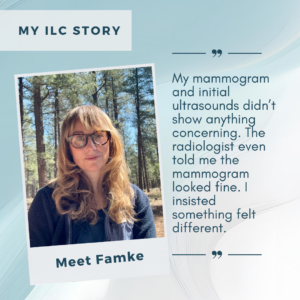
 My name is Famke. I’m originally from Germany and have been living in the U.S. since 2008. I am now in the Bay Area and work in biotech, focusing on oncology drug research. I’m used to thinking about cancer from a scientific perspective. Experiencing it myself was very different.
I first noticed something felt off in my right breast. It wasn’t a distinct lump, but an area that felt firmer, with a defined edge. I also had some pain, which I almost dismissed after reading that breast pain is usually not a sign of cancer. Still, I made an appointment with my OB-GYN. She thought it was likely a fibroadenoma, but given that I was 39, she referred me for imaging. My mammogram and initial ultrasounds didn’t show anything concerning. The radiologist even told me the mammogram looked fine. But I insisted something felt different. After examining me herself, she said, “I see what you mean,” and continued the ultrasound more carefully. That’s when she found a suspicious area, which was biopsied and diagnosed as invasive lobular carcinoma.
At first, we believed the cancer was caught early and confined to the breast. I proceeded with a double mastectomy. The final pathology report told a very different story: the tumor was over eight centimeters, lymph nodes were involved, and margins were not clean. What we thought was early-stage disease was actually stage III, requiring additional surgery, chemotherapy, and radiation.
To understand my diagnosis, I turned to scientific literature, but I also found the Lobular Breast Cancer Alliance early on. Their resources helped clarify how lobular breast cancer differs from ductal disease. I also relied on a science-focused lobular breast cancer Facebook group and later sought a second opinion with a lobular specialist. One gap that stands out is how little large data sets are broken down into ductular vs lobular breast cancer, especially in younger patient populations.
As someone diagnosed in my late 30s, I think a lot about long-term outcomes and late recurrence, the incidences of which are still not well captured for my demographic. I support LBCA as a donor and share my perspective in young survivor spaces, where lobular breast cancer is often underrepresented. I also use LBCA resources in a practical way, bringing information about metastatic patterns to my non-oncology providers so they understand that lobular disease can behave differently.
I recently celebrated my five-year cancerversary and continue long-term hormone therapy. I also share my experience with lobular breast cancer, treatment, and cancer survivorship as a younger patient on my Instagram account, @famke_yeah.
Are you interested in sharing your own lobular breast cancer story? Please email communications@lobularbreastcancer.org to request information about how to submit your story.